
Taking notes in law school is not about writing down everything a professor says or converting an entire textbook into another notebook. With the amount of legislation, case law, academic material and classroom discussion that law students deal with, trying to record everything can actually make studying more difficult.
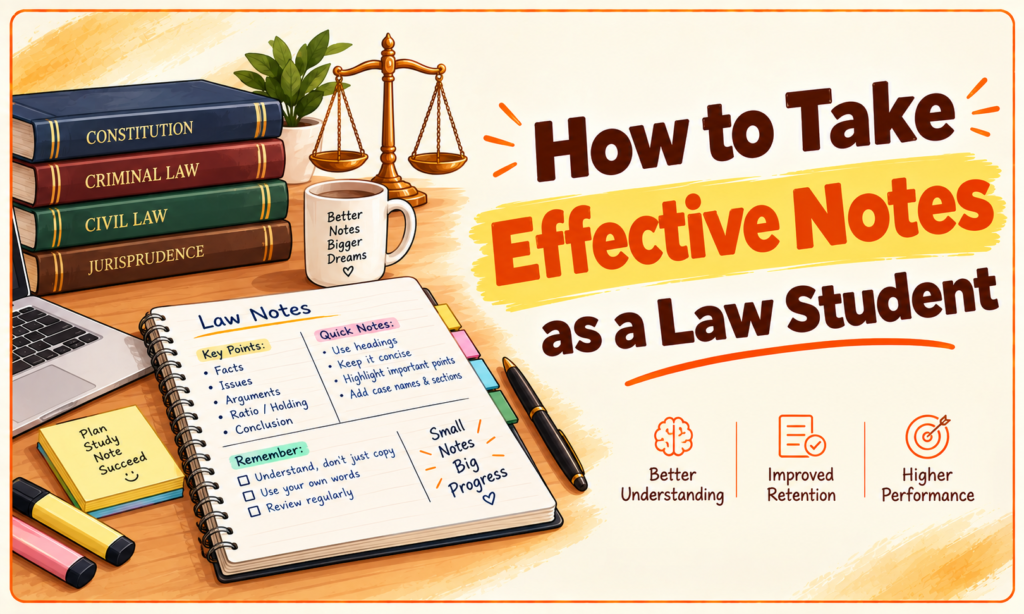
Good notes should help you understand a topic, revise it quickly and find important legal authorities when you need them. They should also be useful several months later, when you have forgotten most of what you wrote during the semester.
1. Do not write everything down
One of the biggest mistakes students make is treating note-taking as transcription. A professor explains a topic, and the student attempts to write every sentence. The result is usually several pages of notes that are difficult to revise and contain very l ittle distinction between important and unimportant information. Instead, listen first and identify the main point. Write down the principle, the relevant provision, important exceptions and anything that your professor explains beyond the textbook.
2. Use the Cornell Method to connect law, cases and explanation
Developed in the 1950s by Walter Pauk, an education professor at Cornell University, and popularised in his book “How to Study in College,” the Cornell Method divides a page into a wide notes column, a narrow cue column for keywords and questions, and a su mmary strip at the bottom.
For a law topic, use the main column for the provision, the principle and important cases; use the cue column to flag exceptions and exam points; and use the bottom strip to summarise the topic in one or two lines. This keeps statute, case law and explanat ion connected instead of scattered across separate pages.
3. Outline Judgments instead of summarising them
Do not turn every judgment into a five -page summary. Outlining is a hierarchical method, taught in most academic writing and study -skills guides, in which the major topic sits at the left margin while subtopics and supporting details are indented beneath it.
Applied to a case, outline facts, issues, arguments, decision, reasoning and ratio decidendi as a nested list rather than prose. This lets you scan a judgment’s structure in a few minutes and drill into any indented detail when you need it.
4. Use Mind Mapping for related concepts
Mind mapping was introduced by British author and educational consultant Tony Buzan in his 1974 BBC series “Use Your Head,” based on the idea that the brain stores knowledge as networks rather than lists.
When a topic branches into several related doctrines, exceptions or overlapping provisions, place the central concept in the middle of the page and let related cases, sections and arguments radiate outward as branches. This works especially well for revisi ng an entire unit before an exam, where linear notes struggle to show how ideas connect.
5. Use charting to compare cases and provisions
Charting arranges information into rows and columns so that several sources can be compared on the same criteria at a glance. For law, set up a column for each case or provision and rows for facts, issue, holding and date, so that conflicting judgments or amended provisions can be compared side by side rather than read separately.
6. Revise and improve your notes
Notes should not be treated as a finished product after the first lecture. Your understanding of a topic will usually improve as you read the Bare Act, judgments and commentaries. A provision that seemed confusing in September may become much clearer after you study the relevant case law in October. Add an important judgment when you encounter one. Correct an incomplete explanation. Remove unnecessary material. Add an exception you initially missed.
Do not make notes just to feel productive
It is possible to spend an entire afternoon making beautiful notes and still not understand the subject. Note-making should support learning, not become a substitute for it.
Before making detailed notes, read the provision. Understand the concept. Read the relevant judgment. Then record what you actually need to remember, using whichever of the above methods fits the material best. As the Roman maxim qui bene distinguit, bene docet suggests, one who distinguishes well teaches well. The same principle applies to note -making: the better you are at distinguishing what is important from what is merely additional information, the more useful your notes become.