
Reading judgments is one of the most important skills a law student can develop, but it is also one of the skills that takes time to become comfortable with. A 100 -page judgment can look intimidating, particularly when it contains lengthy facts, multiple a rguments, previous decisions and several legal provisions. The mistake is to approach every judgment as though it has to be memorised from beginning to end.
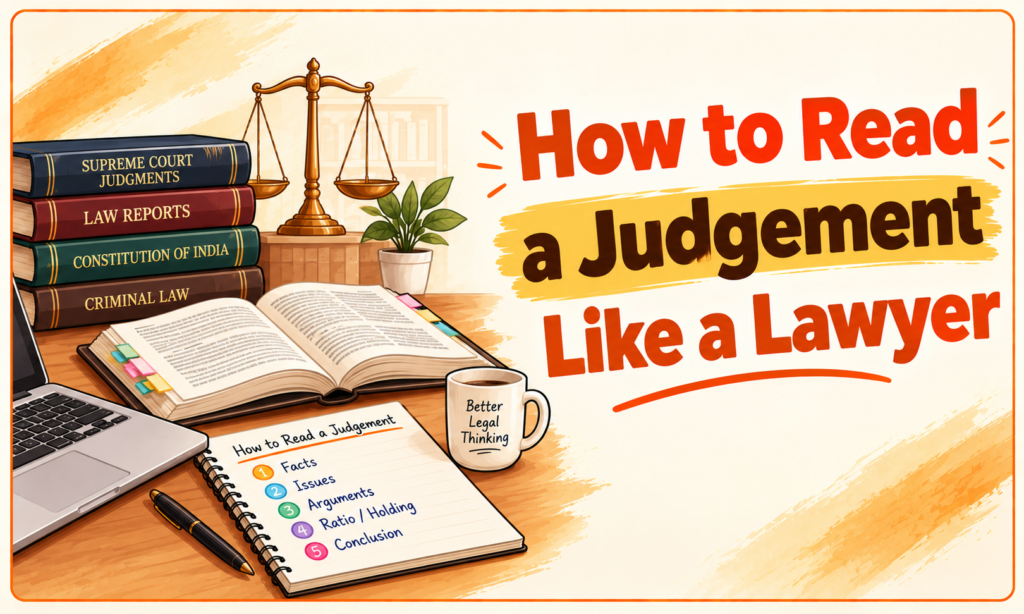
A lawyer does not read a judgment simply to remember what the court said. A lawyer reads it to identify the legal issue, understand the reasoning and determin e how the decision can be applied in another case. The following method can help you approach judgments more effectively.
1. Begin by understanding the background of the dispute
Before getting into the detailed reasoning, understand the circumstances that brought the matter before the court. Read the case title, identify the parties and go through the introductory portion of the judgment. Try to understand the nature of the disput e and the events that led to the litigation. At this stage, do not worry about remembering every factual detail. Focus on the facts that have a bearing on the legal issue before the court. For example, if a case concerns the validity of a contract, you do not necessarily need to remember every detail of the parties’ business relationship. Focus on the circumstances that resulted in the contract being challenged or disputed. Once you understand the background of the dispute, the arguments and reasoning that follow become considerably easier to understand.
2. Identify the precise legal issue before the court
After understanding the facts, ask yourself: what question does the court actually have to decide? This is the legal issue. A judgment may contain several facts and arguments, but the court is usually deciding one or more specific questions of law. Identifying those questions gives you a clear direction while reading the judgment.
For example, instead of simply writing, “This case is about a contract dispute,” the issue might be framed more precisely as: “Whether the agreement between the parties constitutes a valid and enforceable contract under the applicable law?” The more precisely you identify the issue, the easier it becomes to understand why particular provisions and precedents are discussed. A useful test is to frame the issue as a question that can ultimately be answered through a legal conclusion.
3. Identify the relevant legal provisions and authorities
Once you have identified the issue, determine the legal provisions that the court is applying. Look for the relevant Articles, sections, rules or regulations referred to in the judgment. Whenever possible, read those provisions separately in the original legislation. This is where the Bare Act becomes important. Do not assume that the judgment alone is sufficient to understand the statutory provision.
The court may quote only a part of the provision or interpret it in the context of the particular facts before it. Also pay attention to the previous judgments relied upon by the court. If the court repeatedly refers to a particular precedent, that decision is likely to be important to understanding the legal principle being applied. At this stage, you are essentially establishing the legal framework of the case: the relevant provision, the applicable precedents and the issue that the court has to resolve.
4. Understand the arguments advanced by both sides
Do not read a judgment only from the perspective of the party whose position you agree with. Understanding the arguments of both sides is an important part of developing legal reasoning. As you read, ask yourself what each party is trying to establish and which legal provisions or authorities they rely upon. Try to identify the strongest argument advanced by each side. This becomes particularly useful in cases where the legal position is not straightforward. In many disputes, both parties may
have reasonable legal arguments. The role of the court is then to determine which interpretation is supported by the law and applicable precedent. Understanding both sides before reaching the court’s reasoning makes it much easier to appreciate why the court accepted one argument and rejected another.
5. Focus on how the court reached its conclusion
This is arguably the most important part of reading a judgment. Do not stop after identifying what the court decided. Ask why the court reached that conclusion. Examine how the court interpreted the relevant provision, dealt with previous judgments and app lied the law to the facts. If the court rejects an argument, understand the reason for doing so. If it distinguishes an earlier judgment, identify the factual or legal distinction that the court considered important. This is where reading a judgment becomes an exercise in legal reasoning rather than simply an exercise in information gathering.
A useful question to keep asking is:
“Why did the court adopt this interpretation instead of the alternative?” The reasoning that answers this question will often be the most valuable part of the judgment.
6. Identify the Obiter Dicta
Before identifying the ratio decidendi, it is important to understand the observations made by the court that are not essential to the final decision. Obiter dicta refers to observations or remarks made by a judge that are not necessary for deciding the particular issue before the court. Such observations may still be persuasive or academically significant, particularly when made by a higher court.
However, not ever y statement appearing in a judgment forms part of its binding legal principle. While reading, therefore, distinguish between the reasoning that was necessary for the court to reach its decision and observations that go beyond what was required to decide the dispute.
This distinction becomes particularly important when using a judgment as a legal authority in examinations, research papers or legal arguments.
7. Find the Ratio Decidendi
Once you understand the facts, issue, arguments and reasoning, identify the ratio decidendi of the judgment. The ratio decidendi is the legal principle or rule of law that is necessary for the court’s decision. It is the principle that explains why the court reached its particular conclusion on the issue before it. Try to express the ratio in one or two sentences in your own words.
For example, in Donoghue v Stevenson [1932] AC 562 , the House of Lords established the principle that a manufacturer owes a duty of care to the ultimate consumer where the consumer is closely and directly affected by the manufacturer’s actions. This is much more useful for revision than copying several paragraphs from the judgment. The distinction between ratio decidendi and obiter dicta is important because the former forms the legal basis of the decision, whereas the latter consists of observations that are not necessary for deciding the case.
8. Note the Final Decision of the Court
After understanding the reasoning and identifying the legal principle, go to the concluding portion of the judgment and determine the final decision of the court. Was the appeal allowed or dismissed? Was the petition allowed? Was the matter remanded to a lower court? Was a particular provision upheld or declared unconstitutional? What relief, if any, was granted to the parties?
The final decision tells you how the c ourt ultimately resolved the dispute. It is useful to record the final decision separately in your notes because a student may sometimes remember the legal principle established by a case but forget how the particular dispute was ultimately decided.
How to prepare a concise case note?
After reading an important judgment, prepare a short case note. You can use the following structure:
- Facts: What happened?
- Issue: What legal question did the court decide?
- Law: Which provisions and precedents were relevant?
- Arguments: What were the main arguments of both sides?
- Reasoning: Why did the court reach its conclusion?
Obiter Dicta: What significant observations were not necessary for deciding the case? Ratio Decidendi: What legal principle formed the basis of the decision?
Final Decision: How did the court ultimately decide the matter?
This should not become a ten-page exercise for every judgment. For most cases, a concise case note is sufficient. The purpose is to create something that you can understand quickly when revising the case months later. The objective of reading a judgment is not to reach the last page as quickly as possible. It is to understand how the court moved from the facts and legal issues to its final decision. With practice, you will become better at identifying what deserves detailed attention and what can be read more selectively. You will also begin to recognise recurring structures in judicial decisions.